

Procurement teams are not losing sleep over the age of your CMS. What matters to them is whether or not they can pull up a spec sheet instantly, find accurate part details, log in as a distributor without hassle, and grab the technical documents they need right when they need them.
Buyers are digging into vendor options, checking documentation, and building their shortlist long before they ever reach out to sales. If your website is slow or clunky, it’s money slipping through your fingers.
But the reality for many manufacturers is that their websites are still running on old systems built for a different time:
- Updates drag on
- Adding a new product page means calling in a developer
- Security fixes get pushed back
- Integrations with your ERP, CRM, or product data tools feel shaky at best
When the business needs to move quickly to launch a new product, update compliance info, or support distributors in new regions, these problems can slow everything down.
That is exactly why it’s worth giving WordPress another look.
WordPress is a powerful, flexible platform that can handle the complexity of manufacturing websites. Whether you need a large product catalog, multilingual resources, gated distributor content, or support for various B2B buying journeys, the tools are there. Your team can move fast on content, while still giving technical folks the customization and integrations they need.
Ultimately, you need something your team can actually use, that connects smoothly with your business systems, and that can handle heavy traffic without breaking a sweat. When WordPress is set up right, it checks all of those boxes. It helps manufacturers swap out clunky, outdated digital experiences for something faster, more scalable, and much more in tune with how buyers are actually shopping today.
The role of digital platforms in B2B manufacturing procurement
Most manufacturing buyer journeys start quietly, with no fanfare.
Your website needs to act like a sales rep that’s always on call, answering technical questions, guiding visitors to the right solutions, and giving buyers the proof they need. When your site does this well, it builds trust from the very first click.
In manufacturing, your website is often expected to deliver huge libraries and support resources quickly and reliably, no matter where your buyers are. If those files are slow to load, hard to find, or break under pressure, buyers will not stick around. They will look elsewhere.
So for manufacturers, the website extends beyond a digital brochure. It’s your reference library, your self-service portal, and your lead generator all rolled into one. That means you need a platform strategy with real operational muscle behind it.
Key advantages of WordPress
Streamlined content management for internal teams
In most manufacturing companies, the problem is getting it published without running into roadblocks:
- Marketing is busy with product launches.
- Communications needs to share company news and distributor updates.
- Product teams have to get revised specs online fast.
- Safety and compliance might need to post urgent bulletins at a moment’s notice.
On an old CMS, each of these requests can turn into a backlog, a ticket, or just another delay.
With the WordPress Block Editor, your team can build and update pages using flexible content blocks, no developer required for everyday changes. That means it’s much easier to launch new landing pages, update product details, share distributor news, or add technical content without ever touching code. Plus, reusable layouts and patterns help you keep your brand consistent, even as you move fast.
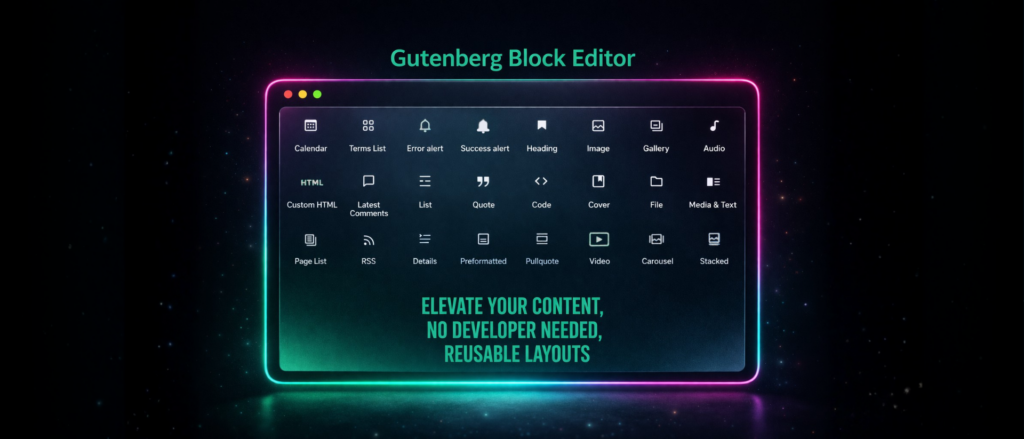
That kind of ease matters, especially in manufacturing where speed and accuracy are everything. If a part spec changes, a certification needs updating, or a new campaign launches, your content team should not be stuck waiting for a development sprint just to make a critical update.
Scalability and custom integrations
Manufacturing websites almost never stand alone.
In reality, your website is at the heart of a much bigger ecosystem. Maybe you are using SAP or Oracle for ERP, Salesforce for CRM, a PIM for product data, inventory databases, DAMs for media, and all sorts of internal tools for quoting, support, or distributor access. If your website cannot talk smoothly with these systems, the user experience falls apart quickly.
That is one of the biggest reasons Enterprise WordPress hosting stands out.
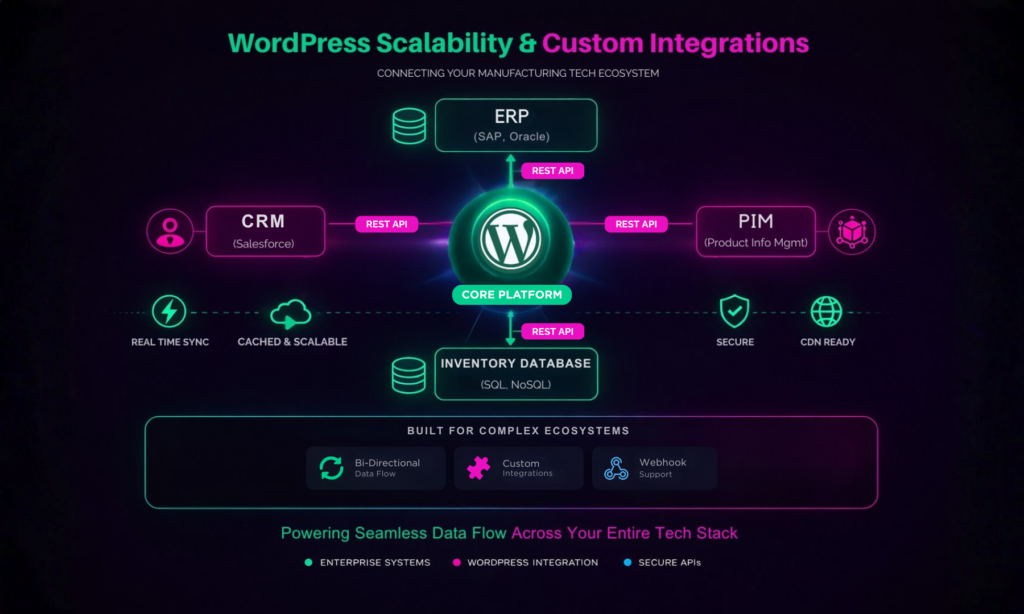
Through the WordPress REST API and custom development, WordPress can act as a flexible presentation layer for complex business data.
- Product pages can pull specifications from a PIM.
- Quote forms can route leads into a CRM.
- Distributor portals can surface account-specific content.
- Inventory status, documentation, and localized assets can all be coordinated across systems in a way that feels seamless to the end user.
Manufacturers often juggle thousands of SKUs, complex product hierarchies, custom filters, role-based access, and content tailored to different regions. Your platform needs to handle all of that without turning into a maintenance nightmare.
But integrations are also where cracks in your infrastructure start to show.
Every product sync, inventory check, gated download, pricing request, and distributor login adds strain to your site. Add in global traffic, big resource libraries, and a busy sales cycle, and things can get fragile fast if your environment is not up to the task. Heavy API use needs smart caching, redundancy, and room to grow.
Driving global visibility and B2B lead generation
Manufacturers are up against rivals across regions, languages, time zones, and supply chains. A solid WordPress setup makes all of this much easier. It supports complex site structures, regional content, and multilingual experiences so global buyers can find what they need, in their own language. Have multiple product lines, regional compliance needs, or distributor networks in different markets? WordPress lets you build a digital presence that actually matches how your business works.
Building visibility across global and multilingual buyer journeys
Visibility comes from product pages, solution pages for specific industries, application content, documentation hubs, FAQs, resource centers, and localized support; pretty much anywhere buyers go to get their questions answered during research.
For manufacturers selling across borders, that visibility must work at scale. Buyers expect to find relevant products, specifications, and compliance information tailored to their region and industry. A structured WordPress setup makes it possible to serve those needs without duplicating effort or creating disconnected sites that are hard to manage.
Performance, structure, and trust in industrial decision‑making
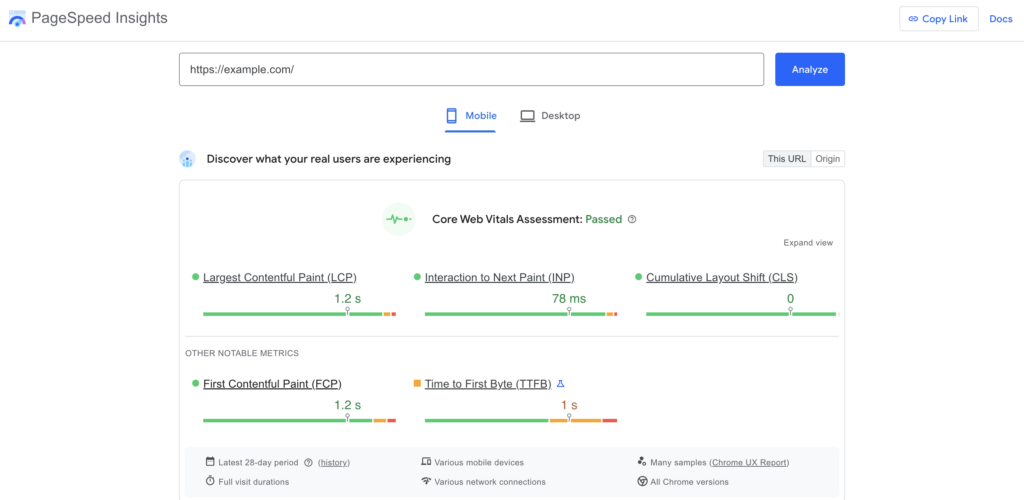
Performance matters just as much. Core Web Vitals are real signals that tell buyers if your site is usable. If your documentation loads slowly, mobile layouts are shaky, or product filters lag, you are creating friction at the exact moment buyers are deciding whether to trust you. In industrial sales, that moment can make or break a deal. If buyers cannot get the technical info they need fast, they will move on.
Structured data is just as important. When you mark up your product and company info, search engines can better understand what you offer, how your content is organized, and which pages match specific buyer needs. For manufacturers with big catalogs and lots of niche products, that extra clarity can make a real difference in getting found.
WordPress is built for both jobs. It works with the latest performance best practices and supports the structured, scalable content you need for a large industrial site. Add in a smart international setup with multilingual and multi-regional support, and your website becomes an engine for broader visibility.
Of course, none of this matters if your site is slow or goes down. Fast load times and rock-solid uptime are the bare minimum for B2B manufacturers. The CMS is important, but the server environment behind it is just as critical.
How manufacturing leaders are modernizing with WordPress
A prime example of enterprise WordPress’s effectiveness in manufacturing is seen in Crowd Favorite’s collaboration with Victaulic, a worldwide leader in mechanical pipe-joining systems. Victaulic’s website is vital for engineers, contractors, and distributors, particularly through its Product Resource Library, which contains thousands of technical documents, product literature, and specification sheets in various languages.
As the library expanded, performance declined, causing pages to load in five to six seconds, making filtering difficult and the outdated interface inconvenient for mobile users in the field. This slow access created significant frustration for such an essential resource hub.
Crowd Favorite tackled this by redesigning the front-end architecture while maintaining Victaulic’s familiar WordPress workflow. Instead of multiple server requests for filtering or paginating, they optimized the experience to load critical data efficiently upfront and enable near-instant filtering, sorting, and navigation within the browser. Additionally, they developed a more intuitive and fully mobile-responsive interface.
The results were impressive: initial load times improved by 40%, dropping from about six seconds to 3.6 seconds, while database queries fell from 35 to 8, a 77% reduction. Most importantly, users gained near-instant access to the resources they needed.
Overcoming security and performance hurdles
A basic WordPress site on cheap hosting is not the same as an enterprise-grade deployment. If you are handling proprietary docs, gated distributor access, product configuration data, and CRM-connected leads, your site is critical to both revenue and risk. That makes security a must-have.
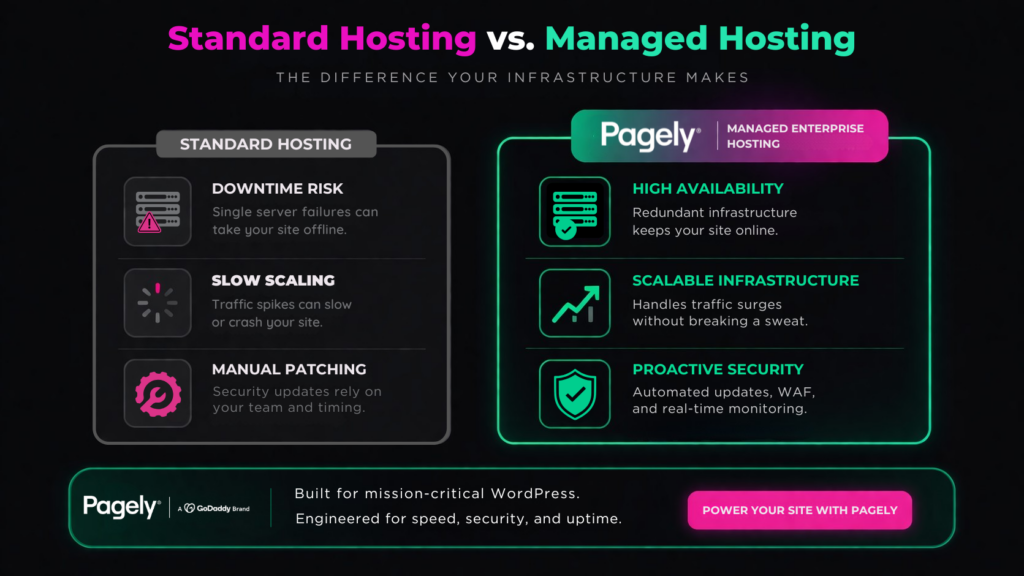
Performance is just as big a concern. Manufacturing sites often have huge media libraries, technical PDFs, product filters, search-heavy catalogs, API integrations, and sudden traffic spikes from launches or distributor activity. A standard setup can buckle under that pressure. Pages slow down, integrations break, admin tasks get frustrating, and downtime starts costing more than you bargained for.
A solid managed WordPress platform takes the infrastructure burden off your team’s shoulders. You get automated scaling, a WordPress-savvy firewall, proactive security patches, reliable backups, resilient architecture, and monitoring that catches problems before they become outages. Instead of burning engineering hours on hosting headaches, you can focus on building the systems and experiences that set your business apart.
So the real question isn’t whether or not WordPress can scale; it can. But is your hosting environment built to handle it?
Get a clear picture of your site’s performance
Even the most capable WordPress platform can become a bottleneck if the underlying architecture isn’t aligned with how your business operates. For manufacturers managing large product catalogs, technical documentation, and system integrations, small inefficiencies can quickly compound into slower load times, frustrated users, and missed opportunities.
To help address that, in partnership with Crowd Favorite, we are providing a free Supply Chain Tech Stack Audit.
This assessment evaluates key areas that directly impact your digital experience, including:
- Page load performance and Core Web Vitals
- Infrastructure and hosting configuration
- Front-end rendering and user interaction speed
- Scalability under traffic and integration demands
This review is designed to surface practical, high-impact opportunities so your team can prioritize what matters most.
See How Your Platform Stacks Up!
Future-proofing your digital footprint
Your website is where buyers do their research, where distributors help themselves, where engineers check the details, and where first impressions are made, often before anyone ever speaks to a human. A fast, secure, and well-integrated WordPress platform is a real competitive edge you can count on.
That is why the smartest move is not just a redesign, but a real look at what is powering your site:
- Can your current platform handle multilingual growth, big documentation libraries, ERP and CRM integrations, and global traffic without slowing your team down?
- Will it stay up when product launches spike demand or when buyers need answers after hours?
- Can it keep up with what modern procurement teams expect?
If you are not sure, it’s time to take a closer look at your infrastructure.
If your business relies on WordPress to generate leads, support partners, and deliver technical content at scale, moving to enterprise WordPress hosting is a smart way to cut risk and make space for growth. And if uptime and resilience are mission-critical, investing in high-availability and secure WordPress hosting is one of the best ways to shore up your digital supply chain.

The post Why Modern Manufacturing Needs Enterprise WordPress appeared first on Pagely.


Recent Comments