

If you’re in manufacturing, your website probably does a lot more than it used to.
Your website is no longer just a digital brochure or a place to park product specs after a trade show. For many manufacturers, it has become the global storefront, the sales enablement hub, the partner portal, the go-to resource for product information, a customer support channel, and the front door to ecommerce all rolled into one.
That shift has raised the stakes.
When your website is slow, product data is scattered, or integrations feel clunky, it’s not just your team that feels the pain. Customers notice, too. Bad digital experiences can sour buying journeys, strain distributor relationships, delay your marketing campaigns, and erode trust. And when things change like product availability or supply chain hiccups, outdated systems make it that much harder to keep up.
That’s why so many manufacturers are ditching rigid, maintenance-heavy platforms in favor of digital foundations that are agile, secure, and built to scale. Modernization is about transforming the entire digital customer experience from the first product search, to quote requests, purchases, support, and everything that happens after the sale.
WordPress gives you flexibility, but it needs to be backed by enterprise-grade hosting, security, performance, and scalability. That’s where a managed platform like Pagely steps in and becomes a key part of your modernization journey.
Your manufacturing website is now a customer experience platform
For years, manufacturing websites were treated as secondary to direct sales, distributor networks, and in-person relationships. That made sense when most interactions happened through sales reps, trade shows, printed catalogs, and long-standing partner relationships.
But the way buyers make decisions has changed.
Today, customers often research independently before they talk to sales. Distributors expect current product information without asking for it manually. Procurement teams want easy access to documentation, pricing, specs, and order details. Engineers may need technical files or product compatibility information before they are ready to speak with someone.
Your digital platform needs to support the entire journey.
A strong manufacturing digital experience should help users:
- Find the right product quickly
- Compare specs and documentation
- Understand availability and delivery timelines
- Access account-specific resources
- Submit quote requests or orders without friction
- Move between content, ecommerce, and support without feeling like they are using disconnected systems
The goal isn’t to replace the human touch. It’s to make those relationships even stronger by giving your customers, distributors, and sales teams the information they need, exactly when they need it.
If your website feels fragmented, slow, or tough to use, your customers will notice. Even worse, they might assume the rest of your business is just as hard to work with.
Legacy systems are creating experience debt
A lot of manufacturers still hang onto aging digital infrastructure because replacing it seems expensive or disruptive. But sticking with old systems comes with its own hidden costs.
Legacy platforms often turn simple updates into a headache. Suddenly, updating a product page means too many handoffs. Publishing new content requires a developer. Integrations break the moment one system changes. Ecommerce feels tacked on instead of seamless. And product data ends up scattered across too many places.
Over time, all of this adds up to what’s known as experience debt.
That debt shows up in ways customers can feel:
- Outdated product information
- Inconsistent specs across pages or regions
- Slow search and filtering
- Confusing quote or checkout flows
- Poor mobile usability
- Broken links to technical resources
- Portals that are hard to navigate
- Long delays when new products need to go live
And it’s not just your customers who feel the pain. Inside the business, marketing can’t move quickly, IT gets bogged down maintaining fragile infrastructure, sales teams invent workarounds, product teams struggle to keep information consistent, and leadership finds it harder to see what’s actually working.
Modernizing your digital platform helps pay down that experience debt by giving you a stronger foundation for content, commerce, data, and integrations.
Buyers expect better ecommerce and product discovery
Manufacturing ecommerce is not always simple. Products may be configurable. Pricing may vary by account, contract, region, or distributor. Some purchases may require quotes, approvals, documentation, or sales consultation.
But just because things are complex doesn’t mean your digital experience should suffer.
B2B buyers now bring consumer-level expectations into every professional interaction. They expect fast pages, clear navigation, accurate search, useful filtering, mobile-friendly interfaces, and secure access to the information they need.
Even if the transaction isn’t as simple as clicking ‘add to cart,’ the journey should still feel intuitive and easy to navigate.
Manufacturers should look closely at areas like:
- Product search and filtering
- Catalog structure
- Technical documentation access
- Quote request flows
- Account-specific pricing or resources
- Distributor and partner portals
- Checkout-style workflows for complex requests
- Product availability and inventory visibility
- Post-sale support and service content
A better ecommerce or product discovery experience doesn’t just make buyers happier. It also lightens your support load, shortens sales cycles, and helps customers make decisions faster.
When customers can find what they need without chasing down a sales rep or hunting through outdated PDFs, your relationship with them gets stronger.
Unified data is the backbone of a better customer experience
One of the biggest challenges manufacturers face is having their data scattered everywhere.
Product information may sit in a PIM. Inventory may live in an ERP. Customer records may live in a CRM. Pricing may be managed through another system. Technical documentation may be stored in a DAM, file system, or legacy portal. Marketing content may live in a CMS.
When your systems don’t talk to each other, customers end up with a fragmented, frustrating experience.
A modern digital platform should make it easier to bring all this information together in ways that actually help your customers. That doesn’t mean you have to rip out every system you have. Often, the smarter move is to connect what’s already working using APIs and smart architecture.
That allows manufacturers to deliver experiences such as:
- Product pages that automatically reflect current specs
- Resource libraries tied to the right product lines
- Customer portals with account-specific content
- Ecommerce flows connected to inventory and order systems
- Sales enablement pages that pull from approved content
- Regional experiences with localized product information
- Analytics that combine customer behavior with business data
The result? A more unified customer experience and a smoother way for your teams to work together behind the scenes.
When marketing, sales, IT, product, and operations all work from connected data, everyone can move faster and with more confidence.
Modern architecture makes integration easier
Most manufacturers don’t have simple tech stacks. Years of systems, workflows, custom tools, and business rules have piled up. That’s why flexibility is so important.
Modern architectures, including decoupled and composable approaches, allow manufacturers to connect systems without forcing everything into one proprietary platform. APIs make it easier to move data between content, commerce, CRM, ERP, inventory, and customer-facing systems.
This matters because modernization shouldn’t lock you into another rigid setup.
A flexible architecture helps manufacturers:
- Preserve systems that still work
- Replace weak links over time
- Launch new digital experiences faster
- Support multiple regions, brands, or business units
- Connect customer-facing platforms with operational systems
- Adapt as ecommerce, AI, and personalization needs evolve
For enterprise WordPress users, this is one of the platform’s strengths. WordPress can serve as a powerful content and experience layer, especially when paired with modern integrations and infrastructure built for enterprise scale. These are the kinds of challenges where strategy and infrastructure need to work together. As manufacturers rethink ecommerce, product discovery, documentation, support, and post-sale engagement, the customer experience has to be planned as a connected system rather than a collection of disconnected touchpoints.
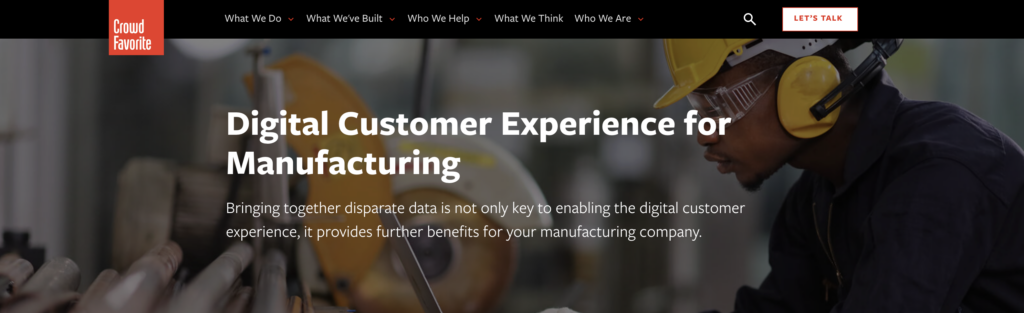
That’s where a strategic partner like Crowd Favorite can help. Their work with complex open-source platforms gives manufacturers a path to unify product data, improve digital customer journeys, and build flexible experiences around the systems they already rely on. Paired with Pagely’s managed WordPress infrastructure, those experiences can stay fast, secure, and scalable as demand grows.
But flexibility alone isn’t enough. Your hosting foundation needs to deliver the speed, security, and reliability that these connected experiences demand.
Performance and stability are now business requirements
Even the most beautiful manufacturing website will fall short if it’s slow, unstable, or unreliable.
Customers expect your pages to load fast. Distributors want portals that work when they need them. Sales teams count on campaigns performing during launches. Ecommerce and quote flows can’t break when things get busy. And your global users shouldn’t be left behind just because your infrastructure was built for a different region or traffic pattern.
Performance is especially important for manufacturers because digital experiences often include heavy assets and complex content, including:
- Technical PDFs
- Spec sheets
- CAD files
- High-resolution product images
- Training materials
- Video
- 3D product renders
- Large catalogs
- Gated partner resources
Modern infrastructure helps deliver those assets quickly and consistently through caching, CDNs, scalable cloud environments, and proactive monitoring.
Stability protects both your revenue and your reputation. A traffic spike during a product launch, industry event, or distributor campaign shouldn’t turn into a crisis. Your platform needs to scale smoothly and stay available when everyone’s watching.
That is the kind of foundation Pagely is built to provide for mission-critical WordPress environments.
Security and trust are part of the customer experience
Security isn’t just an IT issue anymore. It’s a core part of your customer experience.
Manufacturing platforms often handle sensitive information: partner materials, pricing, customer data, gated documentation, order details, and integrations with business-critical systems. As more of the customer journey moves online, the attack surface grows.
A modern platform needs strong security practices built in from the start.
That includes:
- Managed updates and patching
- Strong access controls
- Secure hosting infrastructure
- Proactive monitoring
- Reliable backups
- Protection against common web threats
- Support for compliance and governance needs
- Clear processes for incident response
Your customers might not see every security measure you put in place, but they’ll feel the difference. Secure, reliable platforms build trust. Frequent downtime, broken portals, or obvious security issues do the opposite.
Trust is hard-earned in manufacturing, and your digital platform needs to protect it at every turn.
Modernization helps teams move faster
The internal wins from modernization can be just as important as what your customers see.
When old systems create bottlenecks, every team feels the pain. Marketing waits on developers for simple changes. IT spends too much time on maintenance. Sales teams make their own materials because the website is out of date. Product teams struggle to keep information current. Operations teams get bogged down with requests that customers could handle themselves if the platform worked better.
A modern platform helps smooth out all that friction.
It gives your teams better tools to publish, update, integrate, and analyze. It also makes it clearer who owns what. Marketing can manage content. IT can focus on strategy and governance. Product teams can keep data accurate. Sales can point buyers to reliable resources. And leadership finally gets a clearer view of what’s working.
Some of the biggest operational wins come from simply having fewer workarounds.
When your platform just works, your teams stop wasting time trying to compensate for its shortcomings.
AI, personalization, and IoT depend on the foundation
Manufacturers are also modernizing because the next wave of digital capabilities depends on having a stronger infrastructure in place.
AI-powered search, personalized content, automated support, predictive recommendations, and account-based experiences all need fast systems and connected data. If your product content is inconsistent or customer info is trapped in silos, AI will only make the mess bigger.
The same goes for IoT and real-time operational data.
As more manufacturers connect equipment, sensors, service systems, and logistics data, your customer-facing platforms can become much more useful. Imagine a portal that shows service status, shipment tracking, equipment performance, warranty info, or maintenance resources. But to make that happen, you need secure APIs, reliable infrastructure, and performance that can keep up with constant data movement.
Modernizing now gets you ready for these use cases without forcing another big rebuild down the road.
A future-ready digital platform should be able to support:
- Personalized product recommendations
- Smarter onsite search
- Automated support experiences
- Account-specific portals
- Real-time inventory or order visibility
- IoT-powered service insights
- Better analytics across the customer journey
None of these innovations work well if your foundation is fragile.
Building a future-ready manufacturing platform
Manufacturers are modernizing their digital platforms in 2026 because standing still now costs too much.
Legacy systems slow down marketing, sales, IT, operations, ecommerce, and customer support. They make it harder to serve global buyers, keep product information accurate, integrate business systems, and deliver the kind of digital experience your customers expect today. Modernization is a core business capability.
The goal is to build a digital foundation that helps the business:
- Move faster
- Serve customers better
- Support ecommerce and product discovery
- Connect data across systems
- Scale globally
- Improve security and reliability
- Prepare for AI, personalization, and IoT
- Reduce operational strain
For many manufacturers, WordPress is still a strong enterprise choice. It gives you editorial flexibility, open-source freedom, and a mature ecosystem. When you pair it with the right architecture and enterprise-grade managed hosting, it can handle complex digital experiences without locking your teams into a rigid, proprietary stack.
That is where Pagely fits.
If your manufacturing website is mission-critical, your infrastructure needs to be built for performance, security, scalability, and growth. A modern digital customer experience requires an enterprise-ready platform that can keep pace with your ambitions.
Pagely helps enterprise WordPress teams build that foundation with confidence.

The post Why Manufacturers Are Modernizing Their Digital Platforms in 2026 appeared first on Pagely.


Recent Comments